
Local Antihero: How Sam Fender's Rise To Fame Dulled His Edge

Sam Fender at Southside Festival 2025. Picture: Thomas Niedermueller/Getty Images
Sam Fender entered the indie rock scene as North Shields' humble but hungry underground boy, playing shows at grassroots venues like Newcastle’s 180 capacity The Cluny 2. His fans might have frequented the O2 Academy in the era of £25 Thursday night gigs, idolising other bands such as The 1975, Circa Waves, The Vaccines…Now he sells out multiple shows at NUFC’s home of St James’ Park to a sea of 52,000 night after night. And his fans also like… who? Oh, NUFC.
If you listen to Sam Fender’s 2018 EP Dead Boys, a fantastic prelude to his equally impressive first album Hypersonic Missiles in 2019, we hear an angry adolescent. Seething with dissatisfaction at his hometown and the opportunities it denied him, the two projects send a loud, clear message that activates inside of me and every other poor and / or passionate teen in maybe a 25-mile radius. I can still recall the first time I heard ‘Hypersonic Missiles’, closely followed by ‘Will We Talk?’and ‘Saturday’(the classic Fender introduction), and saying man, this lad just gets it. He symbolised class awareness, a frustration of privilege blockades, and an exhaustion of the rinse and repeat instant gratification cycle of the working class areas he frequented as a young musician. Aware, reflective, depressed, Sam Fender spoke to fitting in externally while crumbling inside, upholding a decades-old social rigmarole.
But Fender, rightfully so, rose on the success scale. Where other indie artists stayed underground, Fender amassed listen upon listen. Somewhere after the sensational success of his second album and its titular single ‘Seventeen Going Under’, Fender became a type of local hero, a phrase that can be used everywhere but carries special weight in Newcastle upon Tyne. Like the Mark Knopfler track of the same name, the Tyne’s “local heroes” are synonymous with the city’s football club, and thus the company and attitude that comes with it.
As this relationship developed, Fender became ‘Our Sam’, and the uniform of his shows transitioned from fishnets, band tees, and eyeliner, to mags shirts and the black and white scarves to match. Despite always being a fan of football and his region, Fender stopped being an active participant in the culture and instead became an infallible, indistinguishable artefact of it.
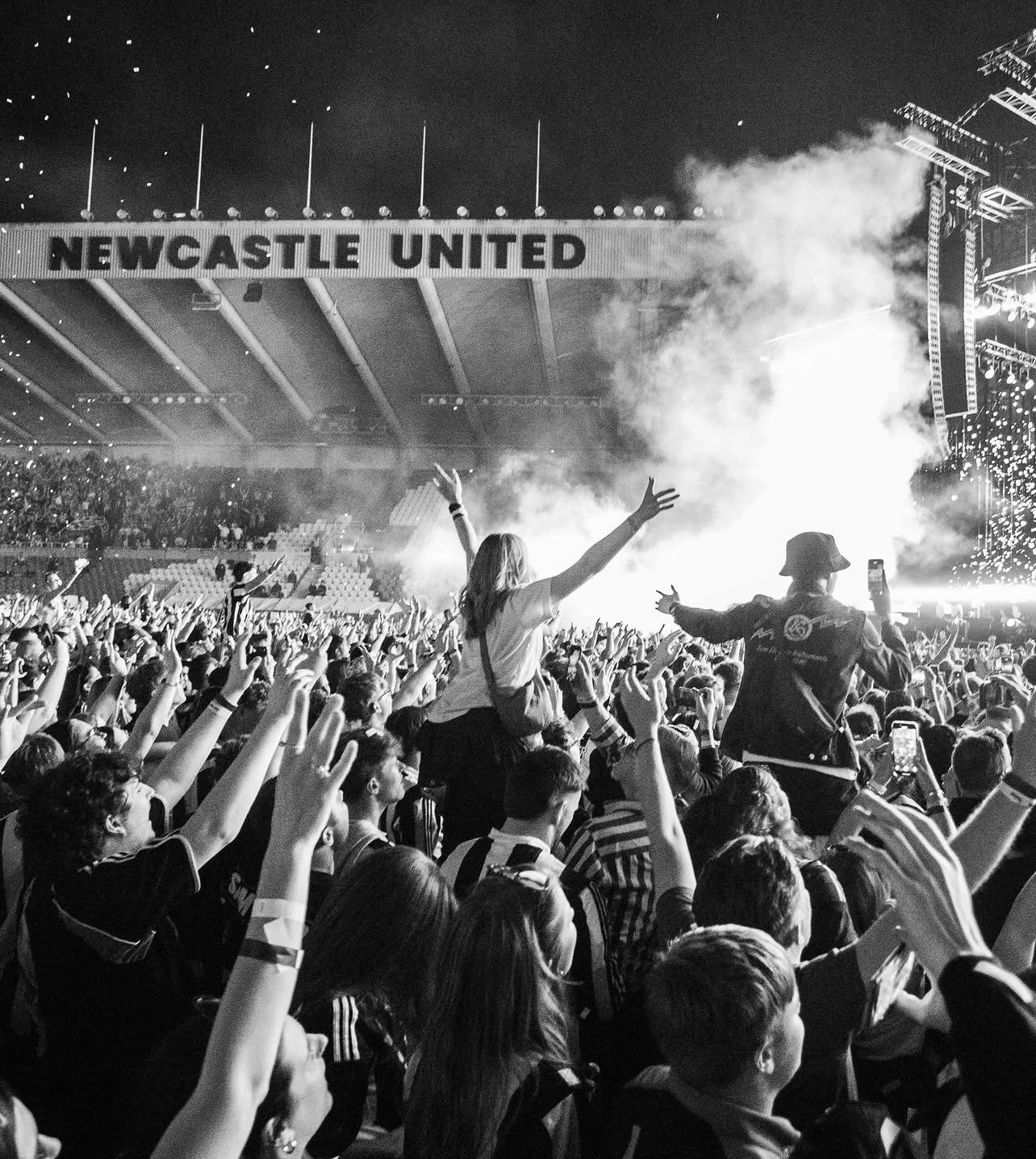
The crowd at St James' Park, 2025. Picture: Jamie MacMillan via Sam Fender's Instagram
But family-friendly shows and cultural adoption of this scale are leading to the restriction of Fender’s ability to be angry. When you represent the people you once criticised, you no longer have the room to write songs slagging them off because they’re standing in your pit. The community are starting to see him as a legacy act, a mere three albums into his career. A success, for sure, but not traditionally a place for growth. A man so talented deserves more than being fossilised as a relic of his time. He’s embarking on this lap of honour, like the comeback tour of a rock band now in their 70s - fun and kinda good - but pushing no boundaries. And it shows in his work.
The desperation to succeed and leave is gone. Fender’s most recent album, People Watching (2025), reads flatly, and I believe this comes from a place of complacency. Take ‘TV Dinner’, for example. It’s a touch of rehash on the ideas seen in ‘Aye’ on the previous album. Whilst the stories told in these songs are for sure Fender’s, the crowd claiming them are straying further and further from the relatability crowd. It perpetuates the tale in Geordieland that we live in a working-class bubble that includes you simply by having an NE postcode. Geordies like to foster the feeling that we’re all still miners fighting against some 70s bureaucracy, which Fender’s storytelling is happy to indulge. Singing about council houses, calling out ‘posh’ people, all helps make him synonymous with his new audience, united under the duress of class consciousness to disguise tribalism. I’m just like you, and you're just like me! When you become synonymous with culture, there’s no fight to be accepted. He’s no longer trying to prove himself, to hustle, to fight back. Why would he? Whatever he puts out will be played over and over on Radio 1, and sung politely back to him by mams in linen trousers. As a result, the pressure that used to sharpen him is gone, and with it, the hunger that made his music so iconic and memorable.
And perhaps this comes from a crazed jealousy-adjacent emotion. He’s found success, seemingly finding peace, in an environment where I wasn’t able to do the same. I can’t tell for sure. But what I do know is, I miss the rage, I miss the passion, the longing for more. And I often wonder if he does too.